
Designation of Members of Constitutional Bodies: A Comparative Analysis between Ecuador and Spain
Article Sidebar
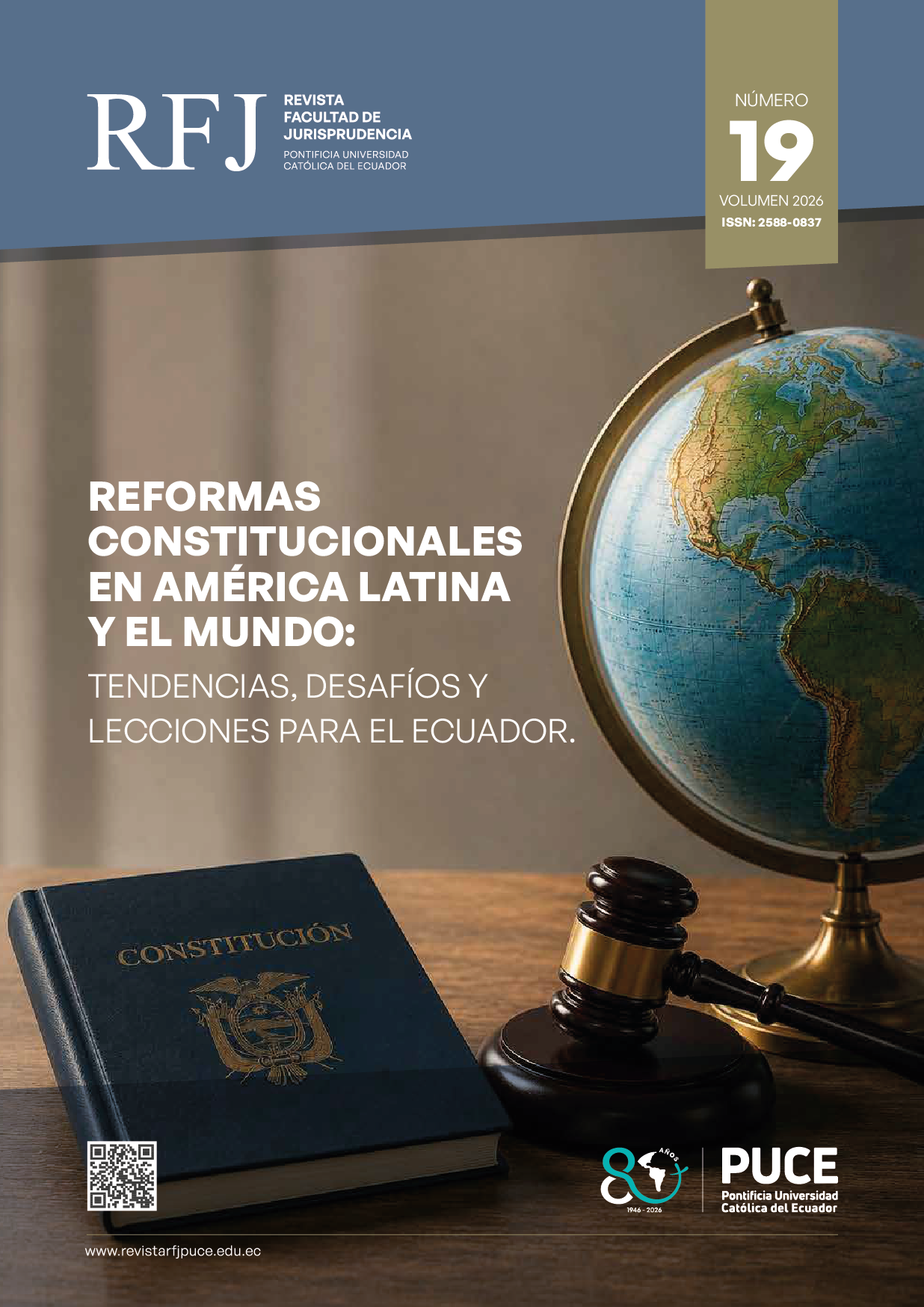
Main Article Content
Abstract
This article develops a comparative analysis between the constitutions of Ecuador and Spain, focusing on the mechanisms for designating authorities of the various constitutional bodies. The aim is to identify elements that can inform the debate on constitutional reforms in Ecuador. It examines structural differences in the legislative, executive, judicial, electoral, and transparency and social control functions, as well as the role of parliament, citizen participation, and the historical contexts of each country. The research concludes that the main difference does not lie in the number of recognized powers, but in the historical context in which each constitution was drafted. While the Spanish constitution (1978) trusted parliament as a space for consensus after a dictatorship, the Ecuadorian constitution (2008) emerged in an environment of deep distrust toward political parties, seeking to innovate with mechanisms of participatory democracy, such as the Council for Citizen Participation and Social Control (CPCCS). However, these innovations failed in practice, as evidenced by early reforms that restored prominence to representative democracy. The article reflects on whether it is more effective to reform existing mechanisms adapted to material reality than to introduce legal structures alien to the historical context and incapable of transforming it.
Article Details
Section
How to Cite
References
Asamblea Constituyente de Ecuador. (2008). Acta No. 80 (9 de julio de 2008, pp. 51-122).
Chueca, R. (1994). Teoría y práctica del bicameralismo en la Constitución Española. Revista Española de Derecho Constitucional, 4(10), 65-90.
Constitución de Ecuador. (2008). Registro Oficial No. 449, 20 de octubre de 2008.
Constitución de España. (1978). Boletín Oficial del Estado, BOE-A-1978-31229.
García, R. (1986). Problemática de la división de poderes en la actualidad. Revista de Estudios Políticos (Nueva Época), (52), 175-190.
Gerpe, M., & Cabellos, M. (2015). La reforma permanente: El Consejo General del Poder Judicial a la búsqueda de un modelo. Revista Española de Derecho Constitucional, (103), 13-44.
Instituto Nacional de Estadística (INE). (2025, 2 de diciembre). Censo Anual de Población. Primeros resultados 2025. Ampliación 2022, 2023 y 2024 [Nota de prensa]. https://www.ine.es/dyngs/Prensa/CensoVariables2025.htm
Ley 1/1996, de 10 de enero, de asistencia jurídica gratuita. (España).
Ley Orgánica 4/2013, de 28 de junio, de reforma del Consejo General del Poder Judicial, por la que se modifica la Ley Orgánica 6/1985, de 1 de julio, del Poder Judicial. (España).
Ley Orgánica 5/1985, de 19 de junio, del Régimen Electoral General. (España).
Nohlen, D. (1987). El parlamentarismo español en una perspectiva sistémico-constitucional. Revista de Ciencia Política, 9(1), 7-15.
Ospina, P. (2012). La participación ciudadana en Ecuador (2009-2012). Horizonte de los derechos humanos, 147-172.
Otero Parga, M. (1997). División de poderes. Antes y ahora. Boletín de la Facultad de Derecho de la Universidad de Santiago, (12), 119-139.
Ruíz, A. (2008). Avances en el régimen político en la Constitución de Montecristi. En Análisis Nueva Constitución (pp. 197-212). Quito: Ministerio de Justicia y Derechos Humanos.
Salgado, H. (1998). ¿Fin del sistema unicameral ecuatoriano? Revista del Instituto de Investigaciones Jurídicas - UNAM, 873-882.
Salgado, H. (2015, 12 de noviembre). La función legislativa en el contexto hiperpresidencial. Hernán Salgado Pesantes. http://hernansalgadopesantes.com/index.php?option=com_content&view=article&id=43:la-funcion-legislativa-en-el-contexto-hiperpresidencial&catid=2:articulos&Itemid=3
Salgado, H. (2015, 29 de diciembre). Debilitamiento de la función legislativa en el Ecuador. Hernán Salgado Pesantes. http://hernansalgadopesantes.com/index.php?option=com_content&view=article&id=44:debilitamiento-de-la-funcion-legislativa-en-el-ecuador-&catid=2:articulos&Itemid=3
Trujillo, J. C. (2011). La Función Judicial antes y después del referéndum. Informe sobre Derechos Humanos, 41-45.
Verdezoto, L. (2008). El régimen político en el proyecto de Constitución. En Análisis Nueva Constitución (pp. 168-195). Quito: Ministerio de Justicia y Derechos Humanos.